Dokkan Babaji
Mahanarayana - Ayurvedic Oil for Joints & Muscles
Mahanarayana - Ayurvedic Oil for Joints & Muscles
Couldn't load pickup availability
Mahanarayana — in Sanskrit, Maha means great, while the name Narayana refers to the protector, the preserver, the sustainer. The oil takes its name from what it is meant for.
For over a thousand years, it has been the oil reached for when the body is asking for real help. When mornings are stiff. When evenings ache. When the joints and the spine — having earned their complaints — begin to shape the day around them.
The preparation is demanding — more than 40 herbs, 5 separate phases, days of continuous work. I've been making medicated oils since 2017, and this one is closer to alchemy than to cooking — the herbs are not steeped, they are transformed: decocted, infused, and worked into a sesame oil over five phases until the oil itself is transformed into the Mahanarayana.
When your body expresses discomfort, reach for the oil, give it time, and it will also meet your pain — not as a painkiller, but the way nourishment does: slowly, from the inside.
No one else makes this oil in Egypt, or anywhere in the region. To find it otherwise, you would have to bring it in from India, Europe, or the US.
Share
Ingredients
Ingredients
A total of 52 ingredients:
Sesame oil (Sesamum indicum)
Goat milk
Agaru (Aquilaria agallocha)
Agnimantha (Premna mucronata)
Ashwagandha (Withania somnifera)
Atibala (Abutilon indicum)
Bala (Sida cordifolia)
Bhringraj (Eclipta alba)
Bilva (Aegle marmelos)
Brihati (Solanum indicum)
Choraka (Angelica glauca)
Daruharidra (Berberis aristata)
Devadaru (Cedrus deodara)
Ela (Elettaria cardamomum)
Gambhari (Gmelina arborea)
Gokshura (Tribulus terrestris)
Haridra (Curcuma longa)
Hrivera (Pavonia odorata)
Jatamansi (Nardostachys jatamansi)
Kantakari (Solanum xanthocarpum)
Karpura (Cinnamomum camphora)
Kumkuma (Crocus sativus)
Kushta (Saussurea costus)
Latakasturi (Abelmoschus moschatus)
Mahabala (Sida rhombifolia)
Manjistha (Rubia cordifolia)
Mashaparni (Teramnus labialis)
Mudgaparni (Vigna trilobata)
Musta (Cyperus rotundus)
Nagakesara (Mesua ferrea)
Nirgundi (Vitex negundo)
Palasha (Butea monosperma)
Patala (Stereospermum suaveolens)
Prasarini (Paederia foetida)
Prishniparni (Uraria picta)
Punarnava (Boerhavia diffusa)
Pushkarmool (Inula racemosa)
Raktachandana (Pterocarpus santalinus)
Rasna (Pluchea lanceolata)
Saindhava (rock salt)
Safed Musli (Chlorophytum borivilianum)
Saunf (Foeniculum vulgare)
Shaileya (Parmelia perlata)
Shalaparni (Desmodium gangeticum)
Shatavari (Asparagus racemosus)
Shyonaka (Oroxylum indicum)
Tagara (Valeriana wallichii)
Tejpatra (Cinnamomum tamala)
Vacha (Acorus calamus)
Varahikanda (Dioscorea bulbifera)
Vidarikanda (Pueraria tuberosa)
Yashtimadhu (Glycyrrhiza glabra)
How to use
How to use
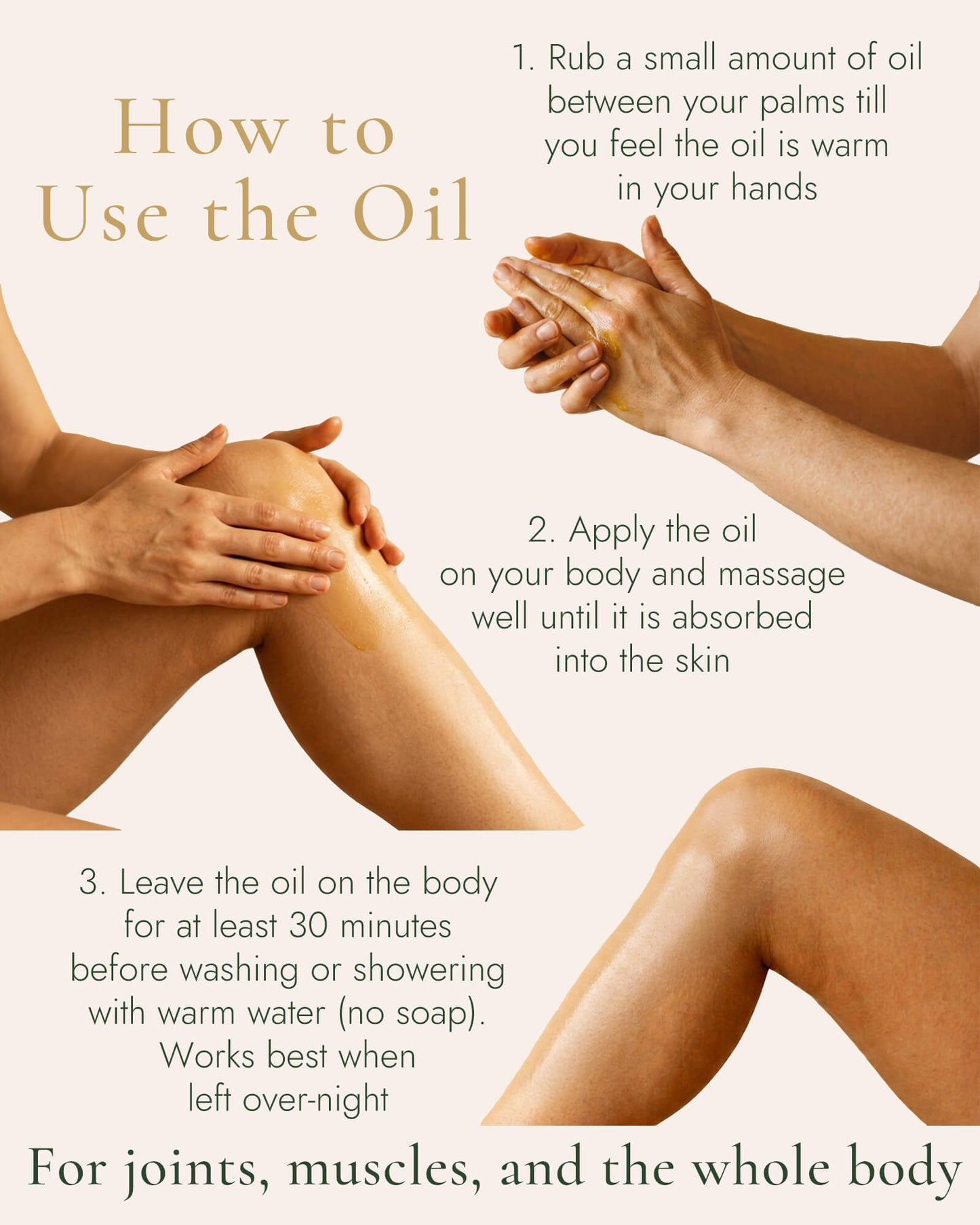
Warm a small amount between your palms and apply directly to the area that needs attention — joints, lower back, shoulders, neck, or muscles.
Massage gently into the skin until the oil is well absorbed and leave it on for at least 30 minutes before washing. For a fuller effect, leave it on overnight.
The oil can be safely used regularly. Apply once or twice a day, as needed.
A little goes a long way. A 100ml bottle typically lasts 3–4 weeks with daily use on one or two small areas.
Benefits
Benefits
The cornerstone oil of Panchakarma, the classical Ayurvedic therapy tradition. Prepared the same way for over a thousand years — the oil practitioners reach for when the body needs real structural care.
Traditionally used for stiff, aching joints — morning stiffness, and the kind that worsens in cold, windy, or dry weather.
Known in the tradition to ease and nourish tired, overworked muscles — from labor, exercise, or the ordinary wear of the day.
In Ayurveda, it is turned to for the structural wear that comes with age — creaking knees, a tight lower back, shoulders that no longer move freely.
A warm, nourishing, Vata-pacifying oil — made to reach past the surface into the deeper tissues the tradition names: muscle, bone, nerve, and marrow.
Known in the tradition to settle the nervous system — the warmth and weight of the oil, worked slowly into the body, is itself a quieting thing.
It is worth knowing that Mahanarayana is not only a classical preparation but a studied one — its long use in the tradition now matched by modern published research in the field of Ayurveda.
Cautions
Cautions
For external use only.
Avoid on broken skin, open wounds, or active skin irritation.
If you are pregnant or nursing, consult a qualified practitioner before use.
The oil has a strong herbal scent — this is normal, and a sign of the preparation's depth.
It will linger on clothing and bedding, so use a towel or old sheets when leaving it on overnight.
If any irritation occurs — which is rare — discontinue use and wash the area with warm water and soap.